Solution: Turning real-time intelligence into operational decisions
Glasgow works with SmartViz to combine real-time occupancy intelligence with existing estate data, building a clearer picture of how its spaces perform and using the insights to answer operational and strategic questions.
Start with the question, prove the value
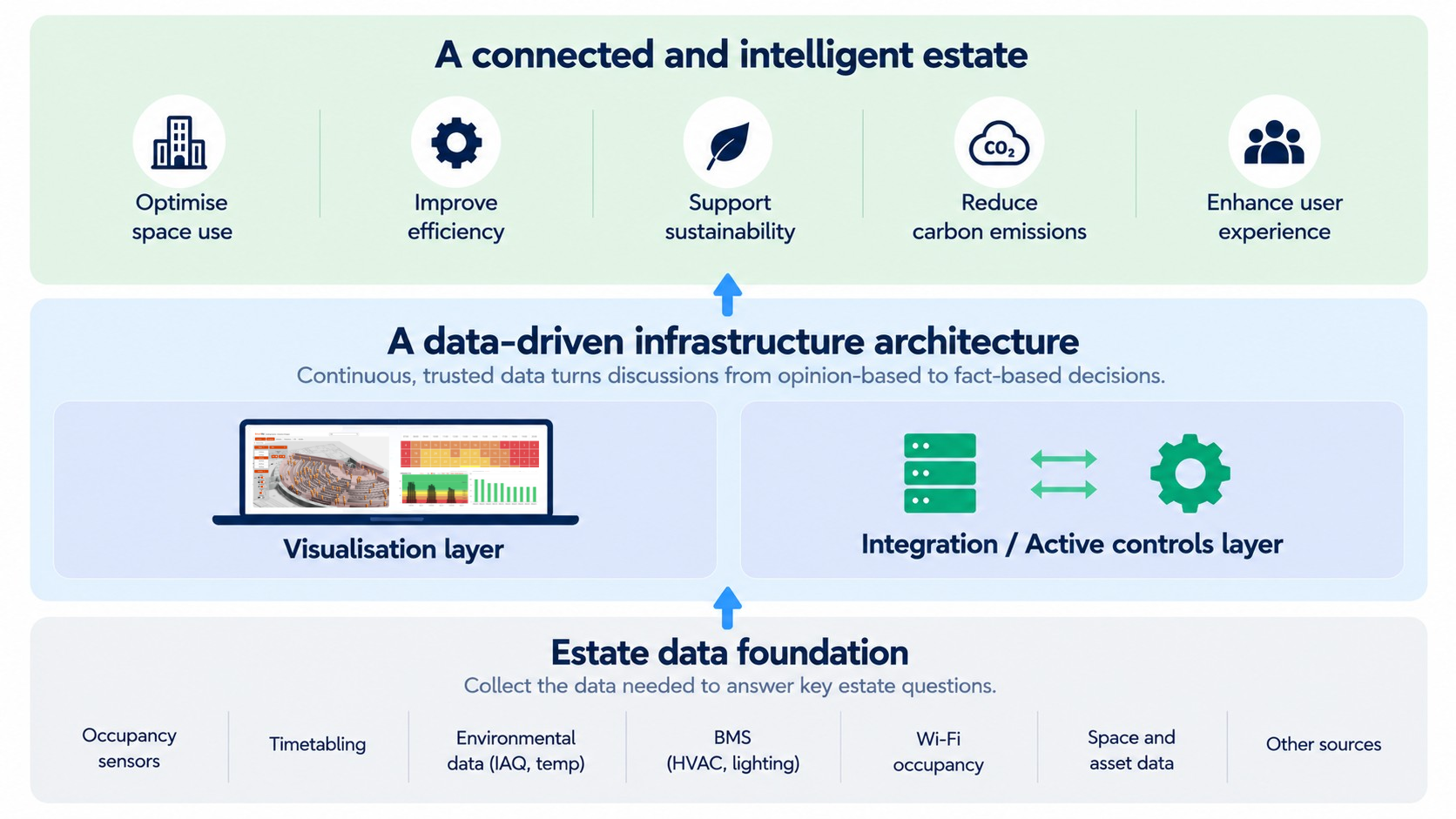
Working with SmartViz, Glasgow is building a stronger evidence base for managing and planning its estate. SmartViz’s digital twin platform combines continuous, real-time occupancy and environmental intelligence with information from other university systems, helping the estates team understand how people actually use spaces, rather than relying solely on timetables, bookings or building capacity.
Starting with specific operational questions and targeted pilots, Glasgow is using this intelligence to compare timetabled capacity with actual attendance, identify underutilised spaces and inform decisions about future space requirements.
The partnership extends beyond technology. SmartViz works closely with Glasgow’s estates team to identify the decisions that matter, interpret the evidence and translate complex data into practical insights that support operational planning and investment decisions.
Continuous and historical evidence also gives Glasgow’s estates team a stronger foundation for conversations with colleagues across the university. By presenting clear evidence of how spaces perform, the team can build trust, encourage constructive discussions and gain support for decisions that may previously have been difficult to reach.
supports decision making process across the university.” – David Gray, Head of Estates Digital and Insight
This growing confidence is helping Glasgow embed data into its organisational culture, strengthening how the university plans, operates and invests in its estate.
Impact: Revealing hidden capacity and unlocking estate value
Glasgow’s data-driven approach is already revealing opportunities to unlock existing capacity, improve estate planning and reduce unnecessary expenditure. The university is also building on these insights to explore smarter operations and better learning environments.
1. Unlock hidden capacity and inform investment
SmartViz’s initial deployment monitored approximately 50 teaching and workspaces, covering around 25,000m² of Glasgow’s estate. Analysis of Term 1 occupancy data revealed peak utilisation of approximately 17.5%, highlighting opportunities to make better use of existing capacity.
Using the AUDE/SMG space utilisation benchmarks of 35% (good) and 50% (aspirational), SmartViz estimated that improving utilisation could theoretically unlock approximately 4,000–8,000m² of equivalent space capacity within the monitored estate.
Applying indicative university construction costs of £3,320/m² and annual operating costs of £139.10/m², this represents a potential opportunity to avoid approximately £14.5m–£27m in future capital expenditure and £0.6m–£1.1m in annual operating costs. These are illustrative estimates rather than realised savings, and would depend on the University’s ability to consolidate, repurpose or avoid constructing additional space.
Example: Turning one lecture theatre into two
One example is JMS 438, a 500-seat lecture theatre where SmartViz occupancy data showed that attendance rarely exceeded 250 students. This revealed an opportunity to reconfigure the theatre into two separate teaching spaces, potentially increasing teaching capacity without new construction.
2. Improve building operations with occupancy insights
By analysing energy consumption alongside occupancy data, Glasgow is exploring how building performance can be assessed against actual demand, identifying opportunities to improve efficiency in spaces that consume significant energy despite low usage.
The university is also planning pilots to investigate how occupancy intelligence could inform active building controls through integration with building management systems (BMS), potentially reducing energy consumption and emissions while maintaining appropriate conditions for building users.
These initiatives could support more efficient building operations, lower carbon emissions and better conditions for the people occupying those spaces in a long term.
3. Shape better learning environments
Occupancy intelligence is also helping Glasgow investigate how different teaching environments are used and what this means for future space planning.
The university has expanded its monitoring across lecture theatres, seminar rooms, collaborative teaching spaces, technology-enabled learning environments and computing labs.
Glasgow is now examining how attendance varies between these spaces and changes throughout the semester. The findings will help the university assess which types of teaching spaces are needed, improve timetabling and plan learning environments around actual student use.
Looking ahead: Towards a connected, intelligent campus
As Glasgow progresses its five-year digital roadmap, the university is building on the value demonstrated through targeted pilots, progressively connecting estate data and expanding the use of intelligence across its buildings.
Working with SmartViz, Glasgow is demonstrating how a more efficient, sustainable and people-centred campus can be developed by building on existing infrastructure, with better evidence informing everyday operations and long-term investment decisions.