What estate do we actually need? It’s a question universities are increasingly having to confront as budgets tighten, operating costs rise and sustainability commitments become harder to deliver.
Before investing in new facilities, expanding existing buildings or making difficult decisions about estate rationalisation, there’s a more fundamental question: How well do we understand the buildings we already have?
Understand our spaces with a building analytics platform
Consider a 500-seat lecture theatre where attendance rarely exceeds 250 students. On paper, it may appear to be a heavily booked and essential teaching facility. In practice, it could represent an opportunity to create additional teaching capacity without constructing anything new. That’s exactly the kind of insight emerging from SmartViz’s work with the University of Glasgow.
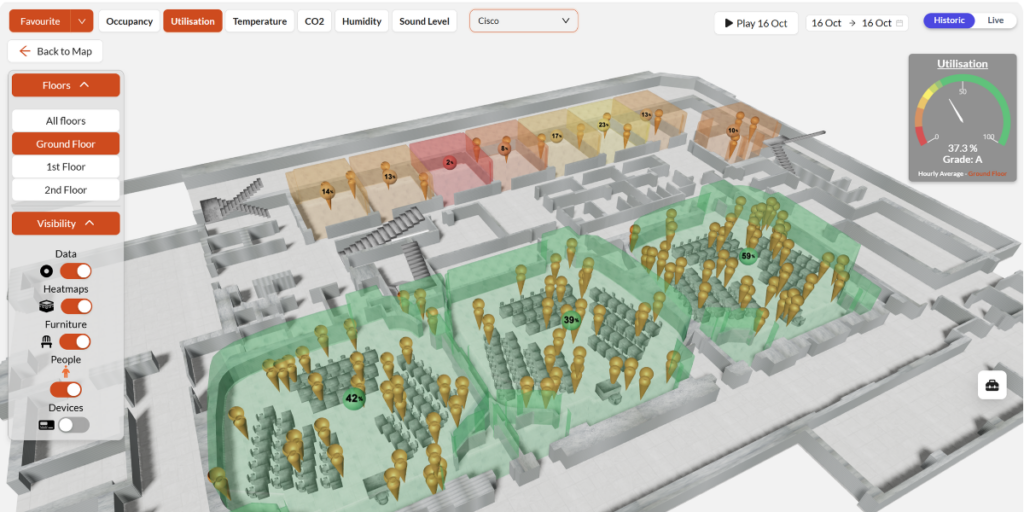
By bringing together data from timetabling systems, occupancy sensors, building management systems (BMS), energy meters and environmental monitoring, a building analytics platform provides a clearer picture of how university estates are actually used and performing.
The real value isn’t simply in collecting more data. It’s in using that evidence to make better decisions about space, energy, investment and student experience.
Four ways universities can put that intelligence to work with building analytics platform
1. Identifying underutilised teaching and office space
A fully booked room isn’t necessarily a fully occupied room.
Universities often rely on timetables, room bookings and design capacities to understand how much space they need. But these tell only part of the story. A lecture theatre might be booked throughout the week while regularly operating at half capacity. Meeting rooms may be reserved but unused. Some study spaces may be overcrowded while others nearby remain largely empty.
By comparing planned activity with actual occupancy, space utilisation analytics reveals these differences and helps estates teams identify opportunities to use existing space more effectively.
Real-world example: University of Glasgow
SmartViz’s initial deployment at the University of Glasgow monitored approximately 50 teaching and working spaces across around 25,000 m² of the estate. One particularly interesting finding concerned a 500-seat lecture theatre where measured attendance rarely exceeded 250 students.
This revealed an opportunity to explore reconfiguring the theatre into two separate teaching spaces, potentially increasing flexibility and teaching capacity without new construction. SmartViz estimated that providing equivalent additional capacity through a new building could cost more than £1 million.
While any reconfiguration would require further feasibility assessment, the finding illustrates a fundamental point: understanding actual demand can reveal opportunities that traditional space-planning information misses.
For universities facing significant capital constraints, this evidence can help inform decisions about room allocation, refurbishment, consolidation and future investment.
2. Aligning energy consumption with actual building use
Most universities already monitor energy consumption. But are they measuring it in a way that reflects how their buildings are actually used?
Energy performance is traditionally assessed in terms of consumption per square metre. This is useful, but it doesn’t necessarily tell us whether energy is being used efficiently relative to the number of people benefiting from it.
Consider two buildings with similar floor areas and energy consumption. One is consistently busy, while the other is occupied by relatively few people. Their energy performance per square metre might look identical. Their energy consumption per occupant could be dramatically different.
By combining occupancy and energy data, a building analytics platform enables universities to examine metrics such as:
- Energy consumption per occupied person or occupant-hour.
- Energy use during occupied and unoccupied periods.
- Heating, ventilation and lighting demand relative to actual building use.
- Differences in energy performance between comparable spaces.
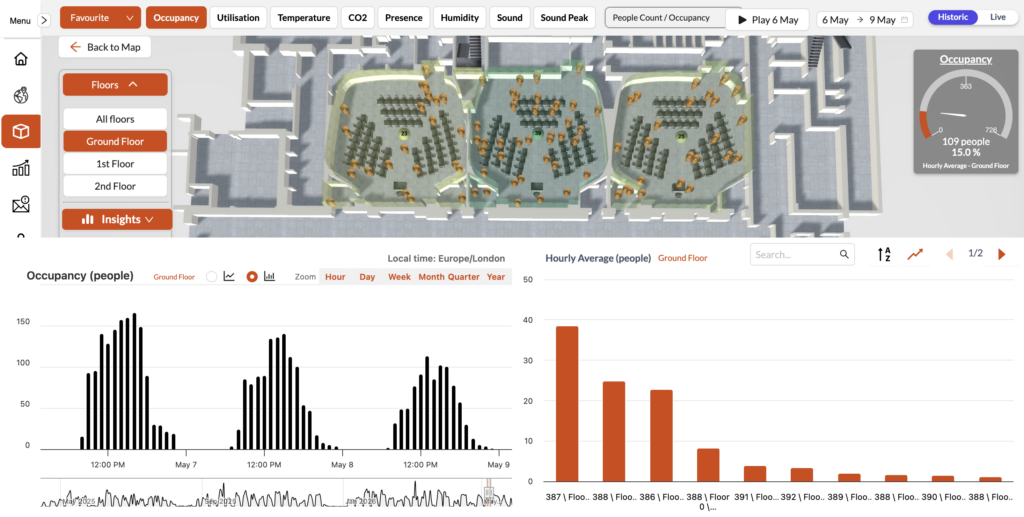
These insights can reveal buildings consuming disproportionate amounts of energy relative to demand. They can also help estates teams identify opportunities to adjust operating schedules, improve building controls and prioritise energy-efficiency investments.
The objective isn’t simply to use less energy. It’s to use energy more intelligently, where and when it’s needed, without compromising comfort or building performance.
For universities balancing cost reduction with net-zero ambitions, this provides an important additional perspective on estate performance.
3. Making facilities management more responsive
University estates are dynamic environments. Teaching patterns change throughout the academic year. Student numbers fluctuate. Some buildings experience intense periods of activity followed by long stretches of relatively low use.
Yet many facilities management activities still operate around fixed schedules and assumptions about demand. Cleaning, maintenance and other operational resources may be allocated in much the same way regardless of whether a space has been heavily used or largely empty.
Occupancy analytics can help change this. By understanding patterns of activity across teaching rooms, offices, circulation areas and shared facilities, estates teams can identify where demand is highest and how it changes over time. This can support more informed decisions about:
- Prioritising cleaning in heavily used areas.
- Reviewing maintenance schedules in relation to actual use.
- Allocating operational resources across buildings.
- Identifying unusual occupancy patterns that may warrant attention.
- Understanding how changes to teaching or working arrangements affect facilities demand.
The aim isn’t to eliminate routine maintenance or compromise standards. It’s to complement established procedures with evidence about actual building use. Over time, this can help universities move towards a more responsive and efficient operating model, where resources are directed according to need rather than assumptions alone.
4. Creating better learning and working environments
Estate efficiency matters, but buildings ultimately exist to support the people who use them. A room might be well utilised and relatively energy efficient, yet still provide a poor learning environment if it’s overcrowded, too warm or inadequately ventilated.
This is why occupancy information becomes more valuable when combined with environmental data. Monitoring temperature, CO₂, humidity and other indoor environmental conditions alongside actual room use can help universities identify spaces that consistently underperform.
For example, estates teams can investigate whether rising CO₂ levels coincide with periods of high occupancy, whether some teaching rooms regularly become uncomfortable, or whether environmental conditions vary significantly between otherwise similar spaces.
These findings can help prioritise investigations and improvements to ventilation, heating and room management. There are also opportunities to make the campus experience more responsive to students’ needs.
Imagine students being able to identify available study spaces, understand how busy different areas are and potentially choose environments that better suit their preferences. Rather than simply managing buildings as physical assets, universities can begin managing them as environments that respond to the people using them.
A more efficient estate should also be a better place to learn, work and collaborate.
Looking ahead, live space availability and environmental insights could even help students find study areas that suit their preferences, making everyday campus experiences more convenient and responsive to their needs.
From building data to better estate decisions
None of these opportunities depends on starting with a major technology transformation.
Many universities already hold valuable information in their timetabling systems, building management systems, energy records and other operational platforms. The challenge is that this information is often fragmented, making it difficult to connect how buildings are used with how they perform.
Affordable, rapidly deployable occupancy and environmental sensors can help fill important gaps in that evidence. Bringing these datasets together through a building analytics platform makes it possible to understand patterns across individual rooms, buildings and entire campuses.
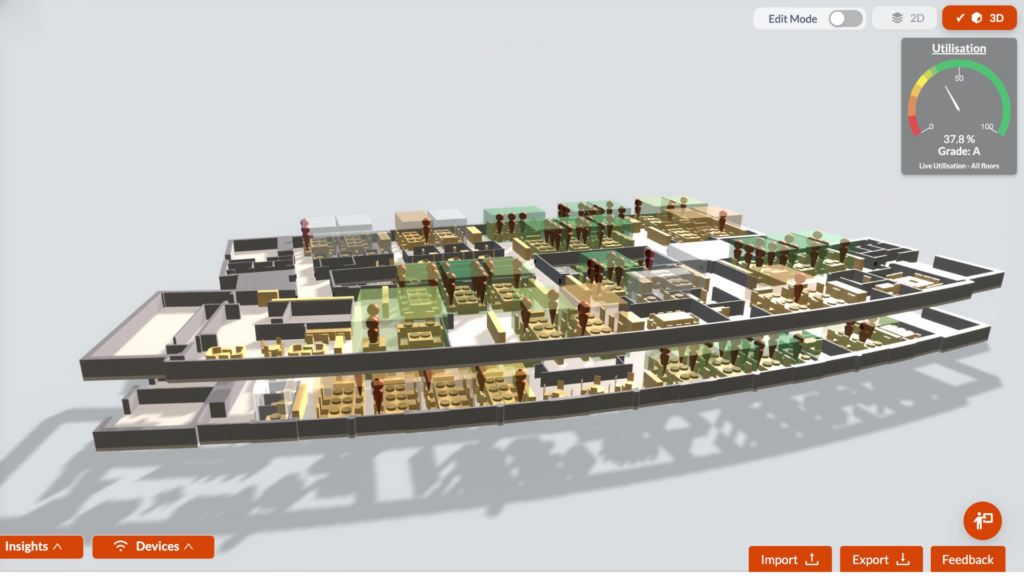
And when that information is presented through intuitive dashboards, heat maps and digital twins, it becomes easier for estates teams and university leadership to explore options, test assumptions and communicate the rationale behind investment decisions.
The starting point doesn’t have to be an entire campus. A small number of representative buildings can provide valuable insights and establish a practical foundation for wider adoption.
How SmartViz supports universities
SmartViz’s people-centred building analytics platform brings together occupancy, space utilisation, indoor environmental quality and energy information to help universities understand how their buildings are actually being used and performing.
Combining operational analytics with an interactive 3D digital twin, SmartViz enables estates teams to explore patterns from individual rooms to entire campuses. The platform integrates with existing building and university systems, while rapidly deployed IoT sensors can provide additional evidence where information is missing.
The focus is on turning building data into practical intelligence, rather than creating another disconnected source of information.
SmartViz supports more than 15 UK universities, alongside schools, NHS organisations, local authorities and commercial estates, helping them make more informed decisions about estate utilisation, operational efficiency, sustainability and investment. Its impact and innovation were recently recognised with two wins at the Building Innovation Awards 2026: Best Asset Management Innovation and Most Innovative New Product (Digital).
The bigger question
For universities facing difficult decisions about their estates, the question isn’t always how much more space they need. It may be how much more they could achieve with the space they already have.
Before committing to new buildings, major refurbishments or long-term operational changes, understanding actual use can reveal opportunities to unlock capacity, reduce waste and improve the experience of students and staff.
Better estate decisions begin with better evidence.
Explore SmartViz’s building analytics solutions to discover what your existing estate data could reveal.