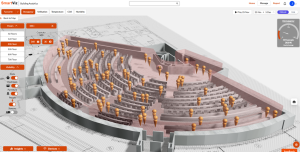

For years, estates teams have walked the corridors with a clipboard, counting heads room by room. Manual surveys are familiar and well established, and they have earned their place. However, as buildings and hospital sites grow busier, a clipboard can only capture so much. People counting sensors pick up where manual counts leave off, watching every room continuously and filling in the hours a survey never sees.
This article compares the two approaches and shows some examples of why continuous measurement beats periodic snapshots for smarter estate decisions.
What People Counting Sensors See That Manual Counts Miss
Periodic snapshots can’t reflect how spaces are used over time, whether that’s a typical day, a term, or a full year. Checking a room once every hour or two gives a useful moment, but everything between those checks stays hidden: mid-afternoon drop-offs in a hot-desking area, a lecture theatre that empties out twenty minutes before the scheduled end time, a spike in a breakout space every Friday afternoon that never shows up in a Monday morning count. These patterns only surface with continuous data, and they’re exactly what estate teams need to plan space with confidence. This becomes particularly problematic in higher education, where demand is driven by diverse variables such as group sizes, teaching methods, contact hours, and specialised room equipment.
Present actual usage patterns
Instead of relying on rough estimates, people counting sensors capture continuous, real-time measurement of space usage, providing continuous measurement of space usage patterns so estate teams see the complete operational picture.
Capture data without disrupting occupants
Beyond these blind spots, the physical act of surveying creates disruption. Having an auditor enter or peek into occupied rooms can be disruptive, particularly during lectures and meetings. People counting sensors eliminate this friction, operating silently in the background to capture anonymous occupancy without intruding on daily work.
Provide live, real-time insights
Finally, manual audits move slowly, often taking weeks to compile into backward-looking spreadsheets. Modern people counting sensors close this operational gap by turning live occupancy data into immediate building utilisation insights. When connected with booking, building management and FM systems, this data can help teams identify no-shows, adjust ventilation according to actual occupancy and target cleaning based on real demand.
Table: People Counting Sensors versus Manual Counts
People Counting Sensors | Manual Counts | |
Accuracy | Consistent and high accuracy when correctly specified and installed | Variable, prone to human error and fatigue |
Data | Real-time, continuous reporting, dwell times, and advanced footfall patterns. | Periodic or sampled, typically limited to one or two weeks over the year |
Cost | Initial hardware and installation expense, lower operating costs over time. | High recurring labour costs for long-term or 24/7 tracking. |
Scalability | Easy to scale across multiple sites | Time consuming and expensive to scale |
How People Counting Sensors Turn Data into Estate Strategy
Real-time measurement of space usage is not the end goal. It is the starting point for understanding how an estate actually works. With people counting sensors running continuously, a team builds up months of evidence rather than a handful of snapshots, and that evidence becomes the basis for benchmarks and better decisions across a portfolio. While how and where to use this data varies by organisation, here are a few ways estate teams put the data to work:
University
In a university, demand for a room can shift with group size or teaching method as much as with the timetable itself. People counting sensors might show a lecture theatre sitting half full during peak enrolment weeks, or a collaborative space filling up in ways a seminar room never does, helping a team decide whether a shortage is real or just how the timetable has always looked.
Hospital
In a hospital, the same sensors might reveal unexpectedly high or low utilisation of waiting areas, consultation rooms or other shared spaces, helping estates teams understand where capacity is under pressure and where space may be underused. These are only a few examples among many. Every estate has its own priorities to explore with people counting sensors.
Start Small with People Counting Sensors, Then Scale
Transitioning to automated space intelligence does not require an immediate, full-scale estate rollout. A practical starting point can be running a targeted pilot in areas with frequent space-shortage complaints, for example, high-demand lecture theatres, hot-desking zones, or outpatient clinics, using high-accuracy people-counting sensors. It enables the team to evaluate the technology in context, seeing firsthand whether real-time monitoring delivers enough clarity to justify scaling it across the wider estate.
Once the value is clear, estates can expand sensor-based utilisation monitoring from individual rooms to entire buildings and multi-site portfolios, establishing a resilient, data-driven estate.